Common Questions about Gibson & Fender Pole Piece Spacing

Posted in Technical on July 1st, 2010 by Loren

We get enough questions about Gibson pole spacing versus Fender pole spacing that it’s worthwhile writing about here in our weekly blog.

The best way to proceed is to review the most common questions.

But first, we’ll start with some basics…..like, what do you mean by Gibson spacing and Fender spacing?

That terminology is actually referring to the physical spacing between the pole pieces. This roughly corresponds to the distance between the strings themselves, but not entirely. (More on that point later). In general terms, the spacing between pole pieces is slightly wider on Fender style pickups, and slightly narrower on Gibson style pickups. The overall difference – when you measure from the centers of the 2 outside pole pieces – is roughly 2 to 3 millimeters. In other words, if you measure from the center of the high E pole piece to the center of the Low E pole piece, a Gibson spaced pickup will measure right around 50 millimeters. A pickup with Fender spacing will measure between 52 and 53 millimeters, depending on the pickup.

This week we’ll discuss how this applies to Humbuckers:

Question 1: How wide is the Fender pole spacing and how wide is the Gibson pole spacing on the Lollar Imperial humbuckers?

A standard Lollar Imperial humbucker has a pole spacing of 50mm

A standard Lollar Imperial humbucker has a pole spacing of about 50mm.


Our traditional Gibson style Lollar Imperial humbuckers have a pole spacing of about 50 mm, as measured from center to center of the two outside pole pieces.

The Fender spaced Lollar Imperial humbucker has a pole spacing of 53mm.

The Fender spaced Lollar Imperial humbucker has a pole spacing of about 53mm.


Our Fender spaced (F-spaced) Imperial humbuckers have a pole spacing of about 53 mm, as measured from center to center of the two outside pole pieces.


Question 2: Will I need a longer route if I install a Fender spaced humbucker?

The outer dimension of all of our (six string) full sized Lollar Imperial humbuckers is exactly the same. The difference between the two pickups is in the spacing of the poles as they’re positioned on the inside of the pickup. In other words, when a metal humbucker cover is machine stamped, the outer rectangle or “box” is the same size. But it’s the distance in between the individual pole pieces that is different. They are stamped through the metal box in slightly different positioning.

This Gibson spaced humbucker cover is 2.75" in length.

This Gibson spaced humbucker cover is 2.75" in length.


Take a look at these  two photos. You’ll see that the outer dimension of the two humbuckers is exactly the same, even though they each have a different pole spacing.

This Fender spaced humbucker cover is 2.75" in length.

This Fender spaced humbucker cover is 2.75" in length.


Question 3: How do I know if I need Fender spacing or not?

This is one of those questions that – to a certain degree – needs to be answered on a “case-by-case basis.” But that being said, generally speaking, if you are purchasing full sized Lollar Imperial humbuckers for a standard Gibson style guitar, then it’s not an issue. You need standard Gibson style humbuckers. However, if you are installing humbuckers onto a guitar that could be considered a “Fender” style guitar, then you’ll want to evaluate the need for a Fender spaced bridge. The most direct approach is to start by measuring the string spacing, right at the bridge.

Question 4: I want to set up my strat with an S-S-H (single-single-humbucker) configuration. Do I need an F-spaced Imperial bridge?

Yes, in most cases. The only exception to this would be if – somehow – a Gibson style bridge had been installed onto a Strat style guitar. That would be more of a “fluke” than anything else. Say, for example, a home-made “Frankenstein” guitar made from parts you happened to have on hand. As far as we know, there are no Gibson style bridges being installed onto Fender style guitar modifications or “clones” of any sort.

Question 5: Do I need an F-spaced Lollar Imperial for my Tele neck?

Probably not. Most of our players, and builders, install a standard Gibson spaced Imperial humbucker in a tele neck. As you know, the string spacing itself becomes narrower as the strings span from the bridge saddles to the nut. Even though it’s a Fender style guitar, the string spacing at the neck position can usually accommodate a standard Gibson spaced neck pickup.

Question 6: My pole pieces don’t line up exactly under my strings, is that a problem?

This is actually completely common for standard guitars. If you think about it, the strings are never the same distance apart as they span from the bridge to the end of the neck. They are furthest apart at the saddles of the bridge, and closest together when sitting at the nut. In between, they sit at various distances apart. That means no two positions on the guitar will relate to a pickup’s pole piece spacing in exactly the same way.

Notice how the stings align a bit differently over the tops of the humbucker pole pieces.

Notice how the stings align a bit differently over the tops of the humbucker pole pieces.

Take a look at this photo. If you look closely, you’ll see that when the strings are closest to the bridge, they actually sit a little wider than the pole pieces of the humbucker pickup. Now take a look at the strings’ position further down the guitar, when they are sitting over the neck pickup. Notice how the strings sit a little more closely aligned with the humbucker pole pieces. This is true for all guitars: If the string spacing at the bridge is wider than the string spacing at the nut, the pole pieces and strings will line up a little differently at each pickup position.

To learn more about our various types of humbuckers, follow this link to the Lollar humbucker section of our web site.

Next week we’ll talk about how to apply these same ideas to projects with single coil pickups.

Tags: , , , , , , ,

Lollar Pickups Welcomes Zenbu Distribution

Posted in Announcements on June 22nd, 2010 by Loren

We are pleased to announce the appointment of Zenbu Co. Ltd. as the exclusive distributor of Lollar products in Japan.

Zenbu Japan Co. Ltd.
www.zenbu-jp.com
3-8-8 Kyomachibori, #101
Nishi-ku, Osaka 550-0003 Japan
Phone: 81-6-6441-2263
Fax: 81-6-6441-2264
Email: zenbuj@dream.com

Zenbu Co. has many years of experience in distributing high quality products in Japan. Also, in a recent visit to Lollar Headquarters, Zenbu’s president Mr. Isao Inoue showed himself to be a fabulous bass player.

Isao Inoue of Zenbu joins several Lollar staff members for an evening of excellent music.

Isao Inoue of Zenbu joins several Lollar staff members for an evening of excellent music.

Shown from left to right are Isao Inoue of Zenbu playing bass; Greg Timmons of Lollar Pickups playing guitar; Randy Barnes of Lollar Pickups playing drums; and Jason Lollar playing the organ.

We are very excited to be working closely with Isao and his entire team, and look forward to making Lollar pickups more accessible than ever to the Japanese market.

Tags: , , , , ,

Best Selling Lollar Pickups - Jazzmaster & Single Coil for Humbucker Rout

Posted in Announcements, Merchandise, Miscellaneous on June 8th, 2010 by Loren

This is the fifth article in our series about best selling Lollar pickups. In this article we’ll talk about some of our best selling items that can’t be classified among the main categories of pickups like strat, tele, and humbucker style pickups.

Lollar Jazzmaster Pickups:

Lollar Jazzmaster style pickups are a consistent favorite. Overall the Lollar Jazzmaster style pickups have a nicely detailed treble and a bit more midrange and bass when compared to a strat style single coil. They also have a very responsive dynamic range.

As you may already know, the size and shape of a pickup coil affect the quality of the tone it will produce. For example, the Jazzmaster coil is very short (1/8″) but very wide. This gives it more surface area and allows the pickup to sense the vibrations of a longer length of the strings. This is part of why they have their own unique tone qualities. To read even more about the unique properties of our Jazzmaster pickups, follow this link to an earlier Lollar pickups blog about Jazzmaster pickups and the Jazzmaster guitar.

Also worth mentioning are our “hybrid” style P-90 / Jazzmaster pickups. They are an interesting option to consider if you are looking for a little more midrange and a little fatter tone than our standard Lollar Jazzmaster. The thickness of the coil and internal construction of the bobbin is actually like a P-90. But the forbon flatwork top and bottom are sized to fit a Jazzmaster sized cover, rather than a P-90 cover. So essentially, they are a P-90 coil wound onto a Jazzmaster sized bobbin. And rather than the fixed AlNiCo pole piece rod magnets of a Jazzmaster, they have the adjustable pole pieces of a P-90. They are also made using two flat bar magnets - just like a P-90. We make the hybrid P-90 / Jazzmaster in all of the same versions that we build our standard P-90s, including an underwound neck and an overwound bridge.

Compare the Lollar P-90 style Jazzmaster to the standard Lollar Jazzmaster.

Compare the Lollar P-90 style Jazzmaster to the standard Lollar Jazzmaster.

This photo shows a side view of the hybrid Lollar P-90 /Jazzmaster (top pickup) and the Lollar standard Jazzmaster (bottom pickup).  When you look at them from this angle you can really see the differences between the two pickups.  You can see the thin Jazzmaster bobbin (1/8″) and the thicker P-90 style bobbin (1/4″).  You can also see the P-90 style bar magnet spanning the full distance alongside the adjustable pole piece screws of the hybrid P-90 / Jazzmaster.  Compare this against the 6 individual pole piece magnets of the standard Jazzmaster.  You can also see how these 6 AlNiCo pole piece magnets are set to a radius.

To read more about either of these styles or to listen to sound clips, follow this link to Lollar Jazzmaster pickups.

Lollar Single Coil for Humbucker Rout:

Another popular “miscellaneous” pickup is our Single Coil for Humbucker Rout. For a “non-standard” pickup, they are a popular choice. The main advantage to this pickup is that they offer a chance to install a single coil pickup into an instrument that is routed for full sized humbuckers. AND - best of all - no routing required.

We like to be precise with our terminology when talking about this pickup. Customers often call and ask if we make a “P-90 for humbucker route.” We think it’s important to point out that this pickup sounds very much like a P-90, but it’s not a “true” P-90. Like we mentioned above, the size and shape of the coil affect the tone. The most popular cosmetic choice is the chrome surround with the matte black top. To learn more about this pickup please follow this link to Lollar Single Coil for Humbucker Rout pickups.

We hope you have enjoyed this series of blogs on best selling Lollar pickups. Like we’ve mentioned before, there is no “wrong” answer. All of our models of pickups have their own unique advantages, and much of what’s involved in the selection process is simply a matter of personal preference. Our best advice is to know what you’d like to accomplish for the particular instrument you’re working with, and then choose the pickups that will help get you there. Contact us if we can help point you in the right direction.

Tags: , , , , , , ,

Best Selling Lollar Humbucker Style Pickups

Posted in Announcements, Merchandise, Miscellaneous on June 1st, 2010 by Loren

This is the fourth article in a series about best selling Lollar pickups. In this post we will talk a little about best selling Lollar Imperial® humbuckers, plus give you an overview of the three full sized, stock humbucking pickups that we build. For this discussion we’ll stick to our full sized humbuckers only.

Lollar Imperial® Humbuckers:

We build three general categories of Lollar Imperial® humbuckers. They are categorized based on their output levels, using the standard wind Imperial as the “baseline” or point of reference. The three categories are the Lollar Imperial (considered our standard wind), the Low Wind Imperial, and the High Wind Imperial.

As the name implies, the Lollar Low Wind Imperial is a slightly lower output pickup as compared to our standard wind Imperial. Our High Wind Imperial is a slightly higher output pickup as compared to our standard wind Imperial. For detailed descriptions and sound clips of the three different full sized humbuckers we build, follow this link to read about Lollar Imperial® humbuckers.

On a side note, this is a good opportunity to clarify the word “wind” as used in the names Low Wind and High Wind. This word refers to the amount of copper wire that is wrapped – or wound – around the humbucker bobbins to form a “coil.” The wire is wrapped around and around the bobbin, literally thousands of times to make each coil. The number of times the wire is wrapped around the bobbin is called the “turn count.” The turn count is the number of times the copper wire is “wound” around the bobbin. The term Low Wind refers to the fact that there are fewer times the copper wire is wound around the bobbin to make a coil. The term High Wind refers to the fact that there are more times the copper wire is wound around the bobbin to make a coil.

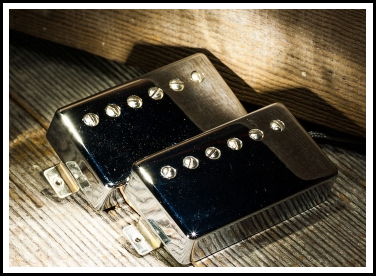
A favorite: standard Lollar Imperial humbuckers, with nickel covers and traditional single conductor leads.

A favorite: standard Lollar Imperial humbuckers, with nickel covers and traditional single conductor leads.

Getting back to best selling Lollar humbuckers: Our standard Lollar Imperial is our best selling humbucker – by far. We sell roughly 50% more Lollar standard Imperials than Low Wind and High Wind Imperials combined.

Each of our humbucker models is available in eight different “finishes.” These include nickel, chrome, gold, aged, heavy aged, double-black, zebra, and reverse zebra. In addition, each of these is available in your choice of either the traditional Gibson style single conductor lead wire or 4-conductor lead wire. So in other words, you have 16 different choices of standard Lollar Imperial sets to choose from.

Among all of these choices, our nickel covered single conductor Lollar Imperial sets are the top sellers. The second most popular Imperials are (again) our nickel covered Imperial sets, but with 4-conductor leads. Our third best selling full sized humbucker is our Low Wind Imperial neck, with nickel cover and single conductor lead wire. This item is popular for two reasons. First, our Low Wind nickel single conductor sets are popular with archtop players. Second, our Low Wind nickel single conductor necks are great for tele applications. The Low Wind Imperial neck (usually nickel, single conductor) is frequently combined with the Lollar Special Tele bridge.

Now, like we have mentioned throughout this series, there really is no “wrong” answer. All of our pickups have their own advantages. The best approach is to know what your specific goals are, and then make your selection based on what you’d like to accomplish for the particular project or guitar you are working on.

Next week’s discussion will be about a few other popular “miscellaneous” items.

Tags: , , , , , ,

Best Selling Lollar P-90 Style Pickups

Posted in Announcements, Merchandise, Miscellaneous on May 25th, 2010 by Loren

This article is third in a series of discussions about best selling Lollar pickups. This session will feature our best selling Lollar P-90 style pickups.

Lollar P-90 Pickups:

The Lollar P-90 is really the “flagship” Lollar pickup, and is often considered “the” pickup that began to draw customers’ attention to Lollar pickups.

Lollar P90 soapbar sets are a strong favorite.

Lollar P90 soapbar sets are a strong favorite.

Our best selling P-90 is the standard wind soapbar style pickup. In fact, we sell over twice as many of this particular model of P-90 than all of our other p-90 pickups combined. That includes all of the other soapbar and dogear models that make up our entire list of P-90 stock models.

Many of the builders we work with install the Lollar standard wind P-90 soapbar sets. Some of these builders include Collings, Godin, Heritage, and National Resophonic.

In fact, as an historical tidbit, it was National Resophonic that was the first established guitar builder that purchased a small run of Lollar P-90 soapbar pickups for use in one of their electric instruments. Since that original purchase in 2002, the Lollar P-90 soapbar has continued to be original equipment on the National Resophonic “Resoelectric” guitar.

For more specific information on our standard P-90 follow this link to Lollar P-90 pickups. And, as we’ve mentioned before, there is really no “wrong” answer when making your individual pickup choice. Each model of Lollar pickups has its own unique advantages. Our best advice is to decide what you’d like to accomplish for the specific project or instrument you are working on, and then base your decision on what’s right for you.

Next week’s discussion about best selling Lollar pickups will focus on best selling Lollar humbuckers.

Tags: , , , , , , , , , ,